How to Play Backgammon
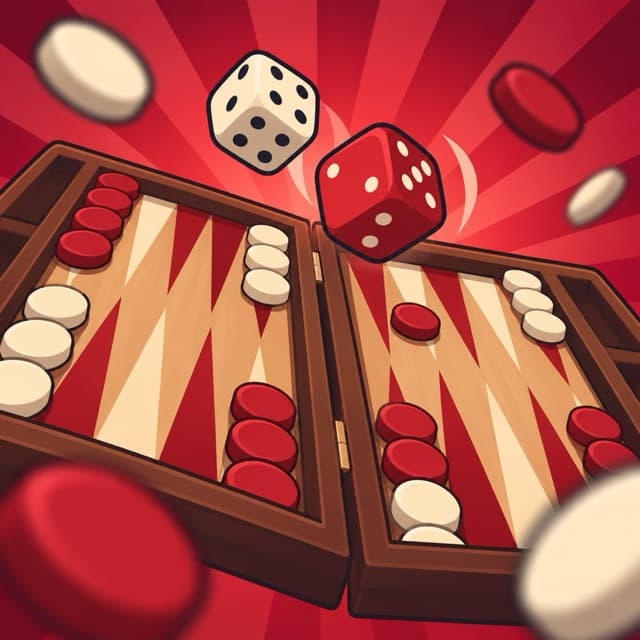
Backgammon is one of the oldest board games still played, a race game where dice and decisions meet. Move your fifteen checkers around the board and bear them off before your opponent — while hitting their stragglers along the way.
By the Multiplayer Games team · Updated · Rules checked against the sources below
Objective
Be the first to move all fifteen of your checkers into your home board and bear them off.
Setup
Each player starts with fifteen checkers in a fixed layout and moves them in opposite directions around the 24 points.
Backgammon rules, step by step
- Roll and move. Roll two dice and move one checker by each number, or one checker by both. Doubles let you move four times.
- Open points only. You can land on any point that's empty, holds your own checkers, or holds just one opposing checker.
- Hitting. Land on a single opposing checker (a 'blot') to send it to the bar. It must re-enter in your home board before its owner can move anything else.
- Bearing off. Once all your checkers are in your home board, remove them using your dice rolls.
- Win. The first player to bear off all fifteen checkers wins.
Backgammon variants, and the rules we use
Backgammon is played slightly differently from place to place. These are the variants you're most likely to meet:
- Doubling cube. Either player can offer to double the stakes; the other accepts or concedes.
- Gammons and backgammons. Winning before your opponent bears off any checkers scores double, or triple.
- Tavla and nardy. Turkish, Middle Eastern and Russian relatives with slightly different rules.
How Backgammon works in Multiplayer Games:
- No doubling cube, and every win counts as one game.
- Checkers on the bar must re-enter before anything else moves.
- Bear off with the exact number, or a higher one when no checker is farther from home.
- If no legal move is possible, the turn passes.
Backgammon strategy for beginners
- Make points (two or more checkers) in your home board — they block your opponent's re-entry.
- Avoid leaving blots where your opponent is likely to hit them.
- Early on, try to escape your two back checkers before your opponent builds a wall.
- If you're far behind in the race, stay back and wait for a shot to hit.
Common mistakes to avoid
- Stacking too many checkers on one point instead of spreading to make new points.
- Leaving blots in your opponent's direct range (six points or fewer away).
Backgammon terms explained
- Blot
- A single checker on a point, which can be hit.
- Point
- One of the 24 triangles — or two or more of your checkers on one, which blocks it.
- Bar
- The middle ridge where hit checkers wait to re-enter.
- Bear off
- Removing checkers from the board once they're all home.
- Prime
- Several blocked points in a row that trap enemy checkers.
A short history of Backgammon
Backgammon belongs to the 'tables' family, one of the oldest groups of board games; race games with dice go back to the Royal Game of Ur in Mesopotamia some 4,500 years ago. The modern rules took shape in England in the 17th and 18th centuries.
The doubling cube, added in New York in the 1920s, turned it into a gambling and tournament game, and computer programs using neural networks transformed expert strategy from the 1990s onwards.
Backgammon FAQ
Sources
We checked these rules against: