How to Play Reversi
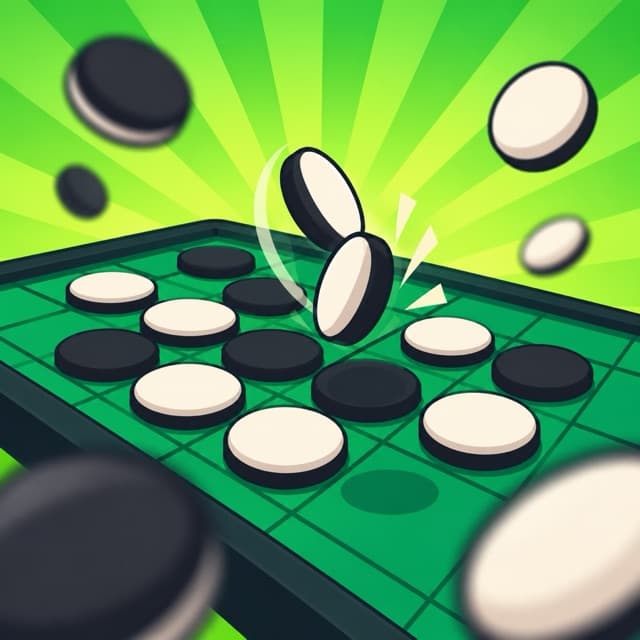
Reversi — sold as Othello — is a two-player game of flipping discs. Sandwich your opponent's discs between two of yours to turn them your colour. The lead can swing wildly, so the last few moves decide everything.
By the Multiplayer Games team · Updated · Rules checked against the sources below
Objective
Have more discs of your colour on the board when the game ends.
Setup
An 8×8 board starts with four discs in the centre, two of each colour placed diagonally.
Reversi rules, step by step
- Place to flip. Each move must place a disc so that one or more lines of your opponent's discs are sandwiched between it and another of your discs.
- Flip the line. Every sandwiched disc — across, down or diagonally — flips to your colour.
- Pass. If you have no legal move, you pass and your opponent plays again.
- Game end. When the board is full or neither player can move, count the discs. Most discs wins.
Reversi variants, and the rules we use
Reversi is played slightly differently from place to place. These are the variants you're most likely to meet:
- Original Reversi. Players placed the first four discs themselves rather than starting from a fixed square.
- Bigger boards. 10×10 Grand Othello changes the corner and edge strategy.
How Reversi works in Multiplayer Games:
- Othello starting position: two of each colour on the diagonals.
- A move must flip at least one disc; otherwise you pass.
- Two passes in a row end the game.
Reversi strategy for beginners
- Corners can never be flipped — take them whenever you can.
- Avoid the squares next to empty corners; they hand your opponent the corner.
- Early on, flipping fewer discs is often better — it limits your opponent's moves.
- Think in terms of mobility: leave yourself many legal moves and your opponent few.
Common mistakes to avoid
- Grabbing as many discs as possible every turn.
- Playing the 'X-squares' diagonally next to an empty corner.
Reversi terms explained
- Corner
- The four corner squares can never be flipped — the most valuable squares on the board.
- X-square
- The square diagonally next to a corner; playing there often gives the corner away.
- Mobility
- How many moves you have. Restricting your opponent's is the heart of strategy.
- Parity
- Trying to make the last move in each region of the board.
A short history of Reversi
Reversi was invented in England in the 1880s — both Lewis Waterman and John W. Mollett claimed it — and it became a popular parlour game in Victorian Britain.
In 1971 Goro Hasegawa in Japan launched Othello, a version with a fixed starting position, and it became a worldwide hit. The World Othello Federation now runs an annual world championship. We use the Othello starting position.
Reversi FAQ
Sources
We checked these rules against: