How to Play Go
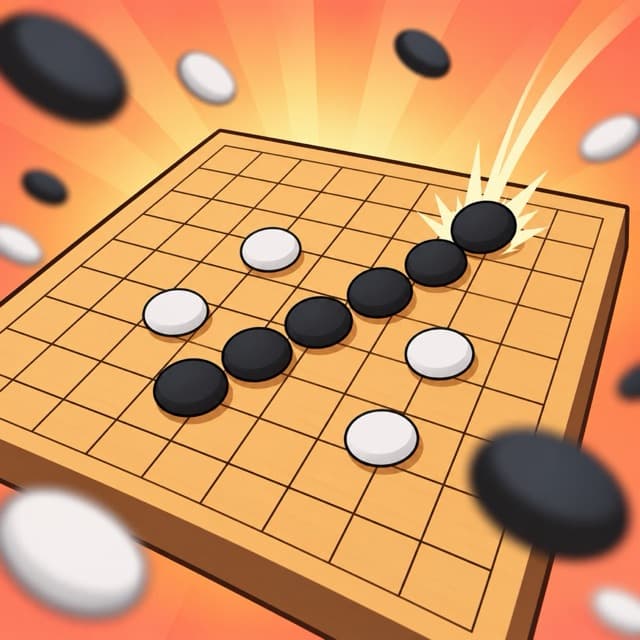
Go is an ancient strategy game from China about surrounding territory. The rules fit on a postcard, yet it's one of the deepest games ever made. Our 9×9 board is the perfect size to learn on.
By the Multiplayer Games team · Updated · Rules checked against the sources below
Objective
Control more of the board — your stones plus the empty points you surround — than your opponent.
Setup
An empty 9×9 grid. Black plays first; players place stones on the intersections, not in the squares.
Go rules, step by step
- Place a stone. On your turn, place one stone on any empty intersection. Stones never move once placed.
- Liberties. The empty points next to a stone or connected group are its liberties.
- Capture. Fill an enemy group's last liberty and it's captured and removed from the board.
- No suicide, no repeats. You can't play where your stone would have no liberties (unless it captures), and you can't immediately recreate the previous board position (the ko rule).
- Pass and score. When neither player wants to move, both pass. Territory plus stones on the board decides the winner.
Go variants, and the rules we use
Go is played slightly differently from place to place. These are the variants you're most likely to meet:
- 19×19 and 13×13. The full board, and the in-between size for improving players.
- Japanese scoring. Counts territory plus captured stones instead of stones on the board. The result is almost always the same.
- Handicap stones. A weaker player starts with extra stones on the board.
How Go works in Multiplayer Games:
- 9×9 board.
- Area (Chinese) scoring: your stones plus the empty points only you surround.
- White receives 6.5 points of komi, so there are no draws.
- Suicide is illegal, and no move may repeat an earlier board position.
Go strategy for beginners
- Corners are easiest to build territory in, then the sides, then the centre.
- Keep your groups connected or give them two separate 'eyes' so they can't be captured.
- Don't chase captures for their own sake — territory wins games.
- When your opponent invades, reduce their space rather than trying to kill everything.
Common mistakes to avoid
- Playing next to your own stones every move, which builds slowly.
- Leaving a group with only one eye — it can still be captured.
- Passing too early while there are still points to fight over.
Go terms explained
- Liberty
- An empty point next to a stone or group.
- Atari
- A group down to one liberty — about to be captured.
- Ko
- The rule that stops a capture-recapture loop.
- Eye
- An empty point inside your group. Two eyes make a group uncapturable.
- Komi
- Points given to white to make up for black moving first.
A short history of Go
Go was played in China more than 2,500 years ago, making it the oldest board game still played in its original form. It spread to Korea and Japan, where it became a professional art, and it is called weiqi in Chinese and baduk in Korean.
For decades it resisted computers, until DeepMind's AlphaGo beat the champion Lee Sedol 4–1 in 2016. The full board is 19×19; the 9×9 board we use is the standard for learning and fast games.
Go FAQ
Sources
We checked these rules against: